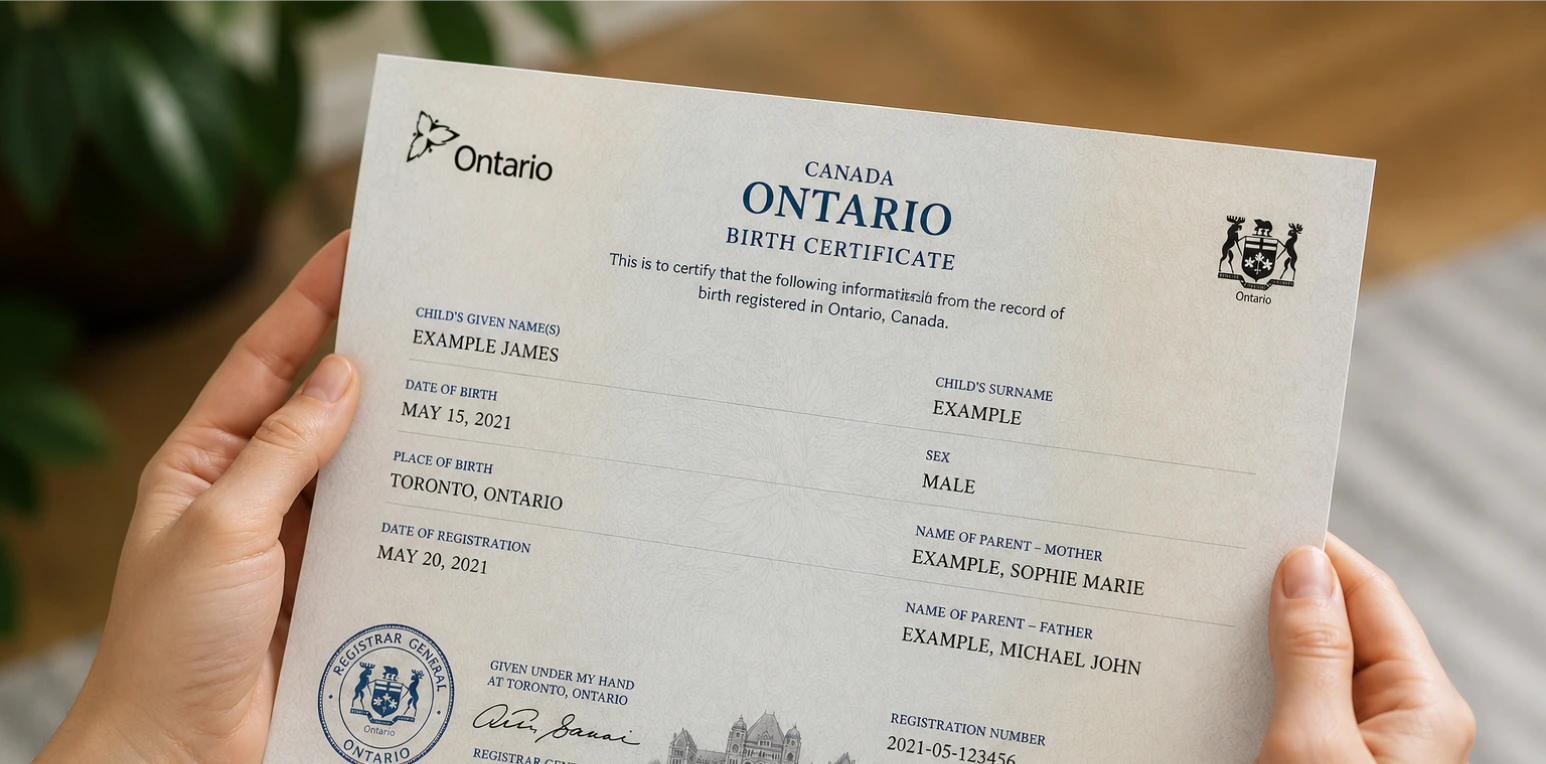
Whether you’re applying for Canadian immigration, planning a marriage abroad, enrolling in a French-language university, or handling an international estate, there’s a good chance you’ll need a certified translation of your birth certificate. And depending on who’s asking for it — IRCC, a French consulate, a Quebec court, a foreign government — you’ll need it translated into a specific variant of French or English, delivered in a specific format, and certified by a recognized translator.
This guide explains when you need a birth certificate translation, which French variant applies to your situation, and what makes a translation officially acceptable in Canada and abroad.
When You Need a Birth Certificate Translated
A birth certificate is one of the most commonly translated documents worldwide because it appears in nearly every major life administrative process. The most frequent situations we handle at Frenchside include:
- Canadian immigration and IRCC applications. Every permanent residence, citizenship, refugee, or family sponsorship application submitted to Immigration, Refugees and Citizenship Canada must include certified translations of any birth certificate issued in a language other than English or French. This is the single most common reason people contact us for this type of translation.
- Marriage abroad or in Canada with a foreign spouse. Marriage registration offices, whether in Quebec, France, or another jurisdiction, routinely require birth certificates translated into the local language and certified by an accredited translator.
- University enrollment. French-speaking universities in Quebec, France, Belgium, or Switzerland often request a certified translation of the birth certificate as part of international student admission files, alongside diplomas and transcripts.
- Estate and inheritance procedures. When a deceased person owned assets across borders, birth certificates of heirs are translated to establish family relationships in probate and succession processes.
- Work permits and visa applications. Many visa categories, particularly those involving family reunification, require certified birth certificate translations.
- Changes of name, adoption processes, or civil status updates. Administrative procedures that require establishing identity historically rely on the birth certificate.
In each of these cases, the wrong kind of translation — even if linguistically accurate — will be rejected. Certification and variant matter.
Canadian French vs European French: Which One Do You Need?
The French used in Quebec and the French used in France differ not only in vocabulary but in administrative terminology. This matters when translating a birth certificate because the reader — a civil servant, a judge, a registrar — expects terminology consistent with their own system. A translation that uses France-specific administrative vocabulary will feel foreign to a Quebec registry, and vice versa. In some cases, the wrong variant can even cause rejection of the document.
You’ll want a Canadian French translation when your document is destined for Canadian authorities: IRCC, Service Canada, Canadian courts, the Quebec civil status registry (Directeur de l’état civil), Canadian universities, or provincial ministries. This covers applications for Canadian citizenship, permanent residence, immigration files, Quebec-based legal procedures, and any submission to a federal or provincial agency. Canadian French follows its own conventions — for example, the term “certificat de naissance” is widely used in Quebec administrative contexts, whereas in France it would more often be referred to as “acte de naissance” or “extrait d’acte de naissance”.
You’ll need a European French translation when the document is destined for the French civil status registry (mairie, préfecture), a French consulate, or any institution in France, Belgium, or Switzerland. This includes university enrollment at French-speaking European institutions, marriage procedures in France, inheritance and succession files handled under French civil law, and visa applications processed by European consulates. European French uses terms and structures specific to the French administrative tradition — including the distinction between “copie intégrale” and “extrait avec filiation” — that a Canadian French translator would not naturally produce.
An English translation is required when your birth certificate was originally issued in French and needs to be submitted to an English-speaking authority. This includes IRCC files routed to English-speaking provinces, U.S. immigration authorities, UK Home Office applications, Australian Department of Home Affairs submissions, and any Canadian court, university, or agency that operates in English.
At Frenchside, we confirm the target variant upfront before starting any birth certificate translation project, so the delivered document fits the exact administrative context it’s meant for. If you’re unsure which variant applies to your situation, we’ll ask where the translation will be submitted and recommend the right version accordingly.
Long-form VS Short-Form Birth Certificates
Another source of confusion when requesting a translation is the distinction between a long-form birth certificate and a short-form version. The two documents look different and contain different information, and not every procedure accepts both.
- A long-form birth certificate, sometimes called a full birth certificate or certified copy of the birth record, contains the complete information originally recorded at birth: the full name, date and place of birth, names of both parents, and any marginal notes added over time (marriage, divorce, death, legal name changes). In France, this corresponds to the “copie intégrale de l’acte de naissance”. In Quebec, it’s typically issued by the Directeur de l’état civil as a certified birth record. This version is usually required for immigration, marriage, and any procedure where filiation must be established.
- A short-form birth certificate or abbreviated birth certificate — corresponding to the French “extrait d’acte de naissance” — is a simplified version containing only essential information. It’s typically used for procedures where filiation isn’t required: ID applications, basic identity verification, employment checks. IRCC generally requires long-form versions, not short-form extracts.
Before requesting a translation, it’s worth confirming with the requesting authority which version they need. Translating the wrong format means starting the process over.
What Makes a Birth Certificate Translation “Certified”
Not every translation is accepted by official authorities. To be used for immigration, legal, or administrative purposes, a birth certificate translation must typically meet three conditions:
It must be performed by a certified translator — a translator officially recognized by a professional association. In Canada, this means OTTIAQ (Quebec), ATIO (Ontario), ATIA (Alberta), STIBC (British Columbia), and other provincial associations. In France, the equivalent is a traducteur assermenté appointed by a Court of Appeal. Requirements for other jurisdictions vary but follow similar logic.
It must be accompanied by a signed statement of accuracy — a formal declaration by the translator that the translation is a true and complete rendering of the original birth record. This statement typically includes the translator’s name, credentials, date, and signature.
It must preserve the original document’s format and structure — including stamps, seals, marginal notes, parental information, dates, and any official markings. Certified translations are usually delivered as a paired document: the translation alongside a copy of the original, each page signed and stamped.
At Frenchside, every certified birth certificate translation is delivered with all three elements, ready for submission to IRCC, Canadian courts, Quebec civil status registries, or foreign authorities.
Turnaround and Pricing
Birth certificate translations are among the most standardized translation projects. A typical document — whether a full birth record, a short-form extract, or a certified copy — is translated and certified within 24 to 72 hours. Rush service is available for urgent immigration or legal deadlines, with same-day delivery possible for shorter documents. Pricing is generally offered at a flat rate per document rather than per word, given the standard length.
Getting Your Birth Certificate Translated
If you need a certified birth certificate translation — into Canadian French, European French, or English — Frenchside can deliver it within 24 to 72 hours, accepted by IRCC, Canadian courts and universities, Quebec civil status registries, and foreign authorities. We handle every format: long-form birth certificates, short-form extracts, birth records, and certified copies issued in any jurisdiction.
Learn more on our certified French translation services page, or contact us directly for a free quote.